
















 Türkçe

Orders & Sales
Dealer Order Management Order Rules (Case, Pallet, Assortment) Quote Management (RFQ) Field Sales & Rep Management Promotions & Volume PricingPricing & Finance
Customer-Specific Pricing & Discounts Account Statements & Balances Credit Limits & Payment Terms Finance & Online Collections Targets, Incentives & CommissionsProducts & Logistics
Product Catalog & Variants Real-Time Stock & Multi-Warehouse Shipping & Fulfillment Returns & Case ManagementSolution
Just a message away
Five Gains From Moving Dealer Orders Off the Phone

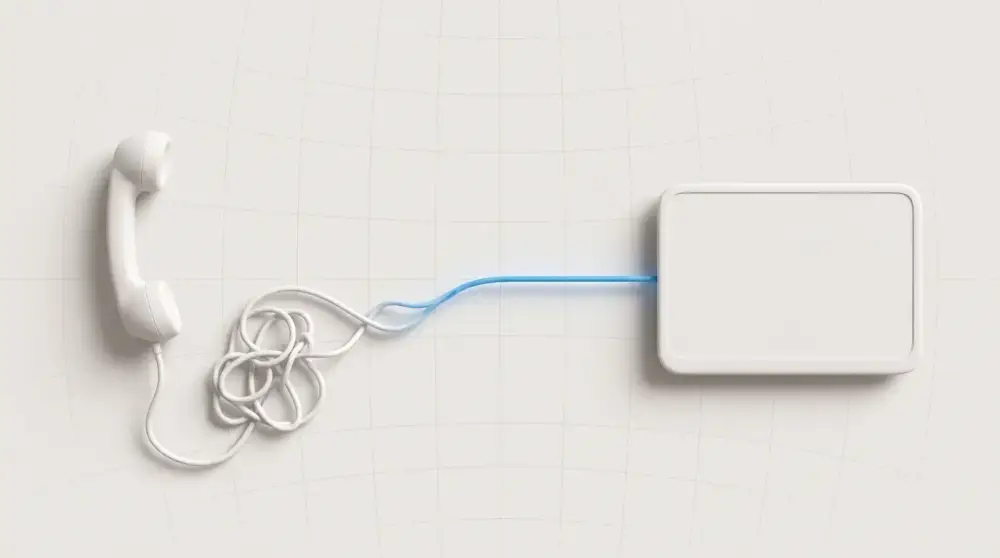
Half past nine in the morning. Three phones are ringing in the sales office, one dealer sends a photo of a handwritten list over WhatsApp, and another calls to remind someone about the discount agreed last week. By lunchtime, part of what was ordered still has not made it into the ERP.
That is not a breakdown. It is an ordinary working day at a great many manufacturers and wholesalers, and its cause is not anybody doing their job badly. Its cause is an order channel that depends on human memory and on somebody being free to pick up the phone. The five headings below describe what moves once that dependency is gone.
1. Order errors end at the source
On the phone, errors come from three places: units confused with inner-case quantities, similar part codes misheard, and assortment rules skipped. On a portal the dealer picks from their own catalog, and case multiples, minimum order quantities, and assortment requirements are attached to the line itself. A wrong quantity is blocked at the moment of ordering, not while the warehouse is picking it. An error you have to correct always costs more than an error that never happened.
2. Price arguments turn into records
"That is not the price I was quoted" gets said sooner or later in every channel where price is set out loud, and nobody has anything to show against it. When the customer-specific list, the discount chain, and the quantity break are all calculated on the portal, the dealer sees their net price while placing the order and confirms at that price. Months later, when a dispute surfaces, what both sides read is the record of which pricing version that line was calculated with.
3. Your sales team stops doing clerical work
Entering an order is not a sales activity; it is data entry. Once dealers raise their own orders, the sales day goes to calling the dealer who has not moved in a while, introducing the new product group, and chasing overdue account items, rather than typing. At most companies this is precisely the change that frees capacity without adding headcount.
4. Ordering is no longer squeezed into office hours
Most dealers spend the day serving their own customers and work out what they are short of in the evening or at the weekend. In a phone-driven channel those orders wait until the next morning, and then queue behind the next morning's calls. With a portal open, the dealer places the list right then and you find it waiting on your screen. The gap looks like a day; in practice it is a shipping wave.
5. Collections move next to the order
In a phone-driven setup, the balance, the remaining credit limit, and the overdue items are the subject of a separate conversation, and usually a postponed one. On a portal the dealer sees their account statement and how much of their limit is used on the same screen where they order, and can clear the balance through virtual POS in the same session. Collection stops being a separate task that needs a reminder and becomes part of the order flow.
Where to start
You do not have to move the whole dealer network in a day. Starting with the dealers who generate the most order lines and the most phone traffic surfaces both the load and the objections early. You do not have to close the phone channel either: the goal is for the phone to become the exception rather than the rule.
Tags :
dealer ordering system
b2b order portal
order accuracy
dealer channel management
wholesale distribution
Recent Articles

Dealer Portal
Dealer Portal
How Field Reps and a Dealer Portal Work Toget...
Oct 30, 2024
Dealer Portal
What Two-Way ERP Sync Actually Means
Oct 20, 2024
Dealer Portal
Putting the Account Statement and Credit Limi...
Oct 17, 2024
Dealer Portal